

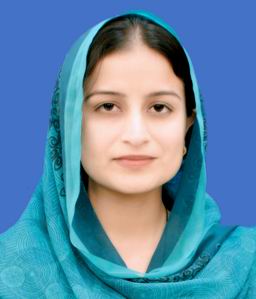
Adila Shafqat
Assistant Professor
PhD Geography
Other Websites
https://orcid.org/my-orcid?orcid=0000-0003-4209-5872About Me
Dr. Adila Shafqat is Assistant Professor of Geography with over 15 years of academic experience in teaching and research, she has established herself as a scholar in Urban Landscape Ecology, with expertise in Geographic Information Systems (GIS), spatial analysis, urban sustainability, and human–environment interactions. Her doctoral research investigates Socio Ecological connection between urban green spaces and modeling of associated socio ecological factors.
Dr. Shafqat has published extensively in reputable national and international peer-reviewed journals and has presented her research at numerous conferences across Pakistan and abroad. Her publications cover diverse themes, including urban green space accessibility, environmental governance, waste management, climate change adaptation, food security, urban planning, and sustainable development. She has also completed professional training and certification programmes from internationally recognized institutions, including Beijing Normal University, ESRI, Columbia University, and the European Commission.
Beyond research, Dr. Shafqat is dedicated to excellence in teaching, academic mentoring, and curriculum development. She teaches undergraduate and postgraduate courses and supervise student research in geospatial sciences and sustainable urban development. She actively promotes interdisciplinary collaboration and is committed to advancing geographical scholarship through innovative research, international academic engagement, and the application of geospatial technologies to inform sustainable policy and planning. Dr. Shafqat actively contributes in departmental activities, academic planning, committee work, and institutional initiatives contributing effectively to the growth and success of the department.
Research Interest Keywords
Contact Info
Research Publication
1. Adila Shafqat, Safdar Ali Shirazi. 2023. “WALKING ACCESSIBILITY OF URBAN GREEN SPACES IN COMPACT CITIES: A CASE STUDY OF BAHAWALPUR.” Pakistan Journal of Science 0. https://doi.org/10.57041/vol75iss02
2. Adila Shafqat. 2023. “Unlocking Creativity: Exploring the Impact of Organizational Climate on Employee Innovation in Public Institutions.” Res Militaris 0. 0
3. A Farasat, S Siddiqui, M Ghous, A Shafqat, A Hanif, M Sohail, S Munir, Muhammad Jabbar. 2023. “EXPLORING THE PARADOX OF POPULATION GROWTH AND FOOD RESOURCES IN PUNJAB–PAKISTAN: REASSESSMENT IN THE LIGHT OF MALTHUSIAN THEORY.” Pakistan Journal of Science 0. https://doi.org/10.57041/vol75iss04
4. Khan, A.A., Arshad,S., Sahfqat,A., Khan,K. 2015. “Urban Growth and Governance of Basic Services in Bahawalpur City of Pakistan.” Pakistan Geographical Review 0. 0
5. Adila Shafqat, Sajid Noor, Munazza Fatima. 2014. “Practices and Challenges of Municipal Solid Waste Management in Bahawalpur City, Pakistan.” Journal of Sustainability Science and Management 9. http://jssm.umt.edu.my/wp-content/uploads/sites/51/2015/02/8w.pdf
6. AA Khan, A Shafqat. 2014. “Assessing the Spatial Distribution and Allocation Gaps of Urban Parks in Bahawalpur City of Punjab, Pakistan, .” Pakistan Journal of Social Sciences (PJSS) 34. 0
7. S Arshad, Shafqat,A., AA Khan, Q Safdar. 2013. “Youth environmental complaints in Bahawalpur city, Pakistan: an informational intervention for local environmental governance, .” Human Geographies-Journal of Studies and Research in Human Geography 7. 10.5719/hgeo.2013.71.71
8. Adila Shafqat. 2011. “The role of the municipality in waste water management in Bahawalpur city.” Management of Environmental Quality 0. . DOI: 10.1108/14777831111122879
9. Adila Shafqat, Sajid Noor. 2010. “Self-Help and Community Organization in Urban Slums,.” Pakistan Geographical Review 65. 0
The Islamia University of Bahawalpur was established in the year 1975 by upgrading historical institute of the Jamia Abbasia.